Power Window Recalls: Switches That Melt, Windows That Pinch
Every NHTSA power window recall in one place: Toyota, Honda and GM switches that may melt, Tesla and Ford windows that may pinch, and repairs that did not hold.
Key takeaways
- NHTSA’s recall file holds 48 power window recalls covering 9.2 million vehicles, counted with overlap. Two kinds dominate: switches that may overheat, melt or catch fire, and windows that may close with too much force or fail to reverse, which breaks the federal standard for power windows (FMVSS 118).
- The biggest are Toyota’s two master-switch recalls for 2006–2011 models including the Camry, RAV4, Corolla, Highlander, Tundra and Yaris: 12V491 (2,519,424 vehicles, 67% reported repaired) and 15V689 (1,814,284, 46%). Many of the same models appear in both.
- Switch fire recalls are the least repaired: 57% overall, against 97% for pinch and auto-reverse recalls, which are often fixed by software.
- Several fixes did not hold. Honda, GM and Ford all recalled cars a second or third time for the same window fault, so a car that was repaired once can still have an open recall. Check your VIN even if the work was done before.
Power window recalls fall into two groups: switches that can overheat and melt, sometimes while the car is parked, and windows that close with too much force or fail to reverse when something is in the way. This guide puts every power window recall in NHTSA’s file in one place: which models are covered, what failed in the records’ own words, and how many cars the automakers report as repaired.
Power window recalls in numbers
We count a recall when NHTSA files it under power window devices and controls, or its subject names a power window, window switch, regulator or motor, or FMVSS 118, and the record is about a window. We leave out records that only sit in that category by mistake: motorhome slide-out rooms, awnings and generators, a school bus defroster knob, bus emergency exits, and a Honda body control module recall (20V771) whose main problems are wipers, the defroster and the rear camera. Sunroof-only recalls under FMVSS 118 are covered in our sunroof recalls guide. One vehicle can be in several of these recalls, so the vehicle total counts it each time.
The fire-risk group is much larger, 6.8 million vehicles against 1.7 million for pinch and closing faults, and less repaired: the automakers’ figures leave an estimated 2.4 million unrepaired, counting overlapping recalls and cars now off the road.
Window switches that may melt or catch fire
Most switch fire recalls describe a similar chain: a window switch or door module, usually the driver’s, is damaged by water, another liquid or poorly applied grease, then shorts or overheats and may melt. What differs is the cause and the cars.
| Recall | Vehicles covered | Cause in the record | Units | Repaired |
|---|---|---|---|---|
| Toyota 12V491 (2012) | 2007–2009 Camry, RAV4, Corolla, Matrix, Tundra, Sequoia, Highlander, Yaris, Scion xB, xD, Pontiac Vibe | Less precise lubrication process; switch may overheat and melt | 2,519,424 | 67% |
| Toyota 15V689 (2015) | 2006–2011 RAV4, 2008–2011 Highlander, 2009–2011 Tundra, Sequoia, Corolla and others | Grease inconsistently applied; debris and moisture may cause a short | 1,814,284 | 46% |
| Chrysler 14V234 (2014) | 2010–2014 Town and Country, Grand Caravan | Vent window switch in the driver’s armrest may overheat | 644,757 | 60% |
| GM 12V406 (2012) | 2006–2007 Trailblazer, Envoy, Rainier, Saab 9-7x, Isuzu Ascender (20 states and D.C.) | Fluid in the driver’s door module; circuit board may short | 278,174 | not reported |
| Honda 12V486 (2012) | 2002–2006 CR-V | Driver-side switch may fail or melt | 268,655 | not reported |
| Honda 20V768 (2020) | 2002–2006 CR-V | Moisture may enter the master switch | 268,655 | 38% |
| GM 18V295 (2018) | 2014–2017 Chevrolet Express, GMC Savana | Liquid may leak into the driver’s switch and cause corrosion | 207,483 | 52% |
| Honda 10V033 / 13V260 | 2007–2008 Fit | Water may reach the master switch | 141,000 / 143,083 | not reported |
Source: NHTSA recalls file and US DOT completion data, retrieved Oct 6, 2026; table compiled by PlainVIN from each campaign’s record. “Repaired” is the automaker’s reported completion rate. Recalls for the same models overlap.
The GM Express and Savana recall reached beyond vans: Jayco (18V564) and Forest River (18V444) filed the same defect for motorhomes built on the Chevrolet van chassis. Chrysler’s 14V234 is for the switch that opens the rear vent windows on the minivans, not the main windows, but the record’s consequence is the same: “An overheated switch may result in a vehicle fire.”
| Automaker | Campaigns | Vehicles potentially affected | Repaired (vehicle-weighted) | Est. not yet repaired |
|---|---|---|---|---|
| Toyota | 2 | 4,333,708 | 58% | 1,817,181 |
| Honda | 5 | 901,504 | 38% | 166,754 |
| General Motors | 5 | 873,852 | 59% | 165,532 |
| Stellantis (FCA US) | 1 | 644,757 | 60% | 255,388 |
| Jayco | 1 | 170 | – | – |
| Forest River | 1 | 53 | – | – |
“Repaired” weights each campaign’s reported completion rate by its vehicle count; “not yet repaired” is the matching estimate. A vehicle in several campaigns is counted in each. Source: NHTSA recalls file and US DOT completion data, retrieved Oct 6, 2026; computed by PlainVIN.
Toyota’s two master switch recalls
Toyota’s 2012 recall covered 2,519,424 vehicles from the 2007–2009 model years. The record says the switches “were built using a less precise process for lubricating the internal components”, which may cause the switch to malfunction and overheat. Dealers inspect the switch and apply a special grease that inhibits heat build-up, or replace a switch that is already damaged. The same record says Toyota owners who have a problem with a switch “should not attempt to make repairs” but should contact a dealer.
Three years later Toyota filed 15V689 for 1,814,284 vehicles, from the 2006 to 2011 model years depending on the model. This time the record says grease “may have been inconsistently applied to the sliding electrical contacts”:
If the sliding electrical contacts are not protected by lubricant, debris and moisture that get into the switch may cause a short circuit and the switch assembly may overheat and melt, increasing the risk of a fire.
NHTSA recall record, Toyota campaign 15V689 (2015)
The remedy is an inspection, then lubricant if nothing is wrong or a new circuit board if it is. The two recalls share models and years (the 2007 and 2009 Camry, 2008–2009 Highlander, 2009 Corolla, Tundra and Sequoia, among others), so the two vehicle counts must not be added. Toyota reports 67% of the first recall and 46% of the second as repaired, which leaves about 985,000 vehicles in 15V689 alone without a reported repair. News reports at the time gave larger worldwide totals; the US figures above are the ones in NHTSA’s record.
Toyota also recalled 662,178 2003–2004 Corolla, Matrix and Pontiac Vibe cars in 2008 (08V162) because the bolts holding the front door glass to the window regulator may loosen, so the glass may separate from the regulator, bind and shatter while the window is moving.
Recalls that came back after the first fix
Read side by side, the records show how often a window recall was filed again for the same cars:
| First recall | Later recall | What the later record says |
|---|---|---|
| Honda 10V033 (2007–2008 Fit) | 13V260 (2013) | A re-recall: the earlier remedy “may have been insufficient”; the plastic cover may separate and let water reach the switch |
| Honda 11V456 (2006 CR-V), 12V486 (2002–2006 CR-V) | 20V768 (2020) | Moisture may enter the master switch; dealers replace it and inspect the wiring harness. 38% reported repaired |
| GM 12V406, 13V248 (2005–2007 Saab 9-7x, 2006–2007 Trailblazer and related SUVs) | 14V404 (2014), 15V599 (2015) | A new remedy for all of 13V248; modules that were coated rather than replaced must be fixed again |
| Ford 16V617 (2017 Escape) | 26V374 (June 2026) | Vehicles “previously repaired incorrectly”; windows may exert excessive force before reversing |
| Ford 24V597 (2024 Ranger, Nautilus) | 25V237 (2025) | 1,177 vehicles repaired incorrectly under the first recall |
| Ford 24V953 (2024–2025 Nautilus) | 25V518 (2025) | 482 vehicles repaired incorrectly |
| Ford 23V507 (2023 Super Duty) | 25V157 (2025) | 9 vehicles repaired incorrectly |
Source: NHTSA recall records for each campaign, retrieved Oct 6, 2026; comparison compiled by PlainVIN.
The GM SUV recalls were also among the few window recalls whose records told owners to keep the car outdoors. Honda’s 2012 CR-V record put it this way:
A switch failure, and a fire, could occur even if the vehicle is not in use. As a precaution, owners are advised to park outside until the recall repair has been performed.
NHTSA recall record, Honda campaign 12V486 (2012)
The GM 12V406, 13V248 and 14V404 records carry the same park-outside advice. For every current recall with that warning, see our Park Outside recall list, and for how often cars burn and why, our car fire statistics.
Windows that pinch: FMVSS 118 and auto-reverse
Federal Motor Vehicle Safety Standard 118 sets out when power windows, partitions and roof panels may close. Under section S4 they may close only with the key in the on, start or accessory position, after the key is turned off until a front door is opened, under continuous pressure on an outside lock or a remote whose range the standard limits (6 or 11 meters, depending on the type), and in a few other narrow cases. A window that can close in any other circumstance must have an automatic reversal system: under S5 it has to stop and reverse before squeezing a test rod with 100 newtons or more, then open again by a set amount (49 CFR 571.118). Section S6 separately requires that window switches inside the car must not start closing a window when pressed by a test sphere.
Most pinch recalls are about that reversal. The largest by far is Tesla’s:
The window automatic reversal system may not react correctly after detecting an obstruction.
NHTSA recall record, Tesla campaign 22V702 (2022)
It covered 1,096,762 2017–2022 Model 3, 2020–2022 Model Y and 2021–2022 Model S and Model X cars, and the over-the-air software remedy is reported 99% complete. Ford has filed the most pinch recalls since 2014. Its 2024 Ranger and Lincoln Nautilus recall (24V597, 70,483 vehicles) says windows closed with the global closing feature may not reverse after detecting an object; the 2024–2025 Nautilus (24V953, 47,818) also failed the minimum reversal distance; the 2025 Lincoln Aviator (25V484, 23,111) covers rear windows. GM’s newest, filed on September 24, 2026 (26V612), covers 29,347 2025–2027 Cadillac OPTIQ SUVs whose front windows may fail to detect an obstruction when closed with the key fob’s express-up function; owner letters are due November 9, 2026, so no repair rate is reported yet.
| Filed | Vehicles (NHTSA wording) | Problem | Units | Repaired |
|---|---|---|---|---|
| Sep 2022 22V702000 | Certain 2017-2022 Model 3, 2020-2022 Model Y, and 2021-2022 Model S and Model X vehicles | Power Windows May Pinch/FMVSS 118 | 1,096,762 | 99% |
| Aug 2024 24V597000 | Certain 2024 Ranger and 2024 Lincoln Nautilus vehicles | Power Windows May Pinch/FMVSS 118 | 70,483 | 85% |
| Dec 2024 24V953000 | Certain 2024-2025 Lincoln Nautilus vehicles | Power Windows May Pinch/FMVSS 118 | 47,818 | 79% |
| Jul 2025 25V484000 | Certain 2025 Lincoln Aviator vehicles | Rear Windows May Fail to Reverse Direction/FMVSS 118 | 23,111 | 97% |
| Jun 2026 26V374000 | Certain 2017 Escape vehicles previously repaired incorrectly under recall number 16V617 | Window Automatic Reversal System Malfunction/FMVSS 118 | 18,124 | – |
| Aug 2016 16V617000 | Certain model year 2017 Ford Escape Titanium and SE vehicles manufactured October 5, 2015, to May 12, 2016 | Power Window Force may be Excessive/FMVSS 118 | 17,985 | 83% |
| Feb 2023 23V099000 | Certain 2023 8 Series Coupe (840i, 840i xDrive, M850i xDrive, M8), 8 Series Convertible (840i, 840i xDrive, M850i xDrive, M8), 8 Series Gran Coupe (840i, 840i xDrive, M850i xDrive and others | Windows May Close Without Key Present/FMVSS 118 | 3,193 | 99% |
| Jul 2023 23V507000 | Certain 2023 Super Duty F250, F350, F450, and F550 vehicles | Front Windows May Not Reverse Direction | 1,339 | 93% |
| Apr 2025 25V237000 | Certain 2024 Ranger and 2024 Lincoln Nautilus vehicles previously repaired incorrectly under recall number 24V-597 | Power Windows May Pinch/FMVSS 118 | 1,177 | 59% |
| Aug 2025 25V518000 | Certain 2024-2025 Lincoln Nautilus vehicles that were repaired incorrectly under recall 24V953 | Window Automatic Reversal System Malfunction/FMVSS 118 | 482 | 57% |
Vehicle descriptions are NHTSA’s own summary wording; “repaired” is the share the manufacturer reports as fixed, and new campaigns start near zero. Source: NHTSA recalls file and US DOT completion data, retrieved Oct 6, 2026.
Older FMVSS 118 recalls were about windows that worked when they should not. In 1998 Ford (98V012001, 57,400 minivans) and Nissan (98V012002, 46,500) recalled minivans whose windows could be closed after the key was off and the passenger door opened; the remedy was a label reminding owners not to leave children unattended. BMW’s 2023 recall (23V099) covers 3,193 cars whose software may still allow the windows and sunroof to be closed after the digital key is removed, and Kia’s 2020 Cadenza recall (22V022) covers rear windows the driver’s switch could operate after the ignition was off.
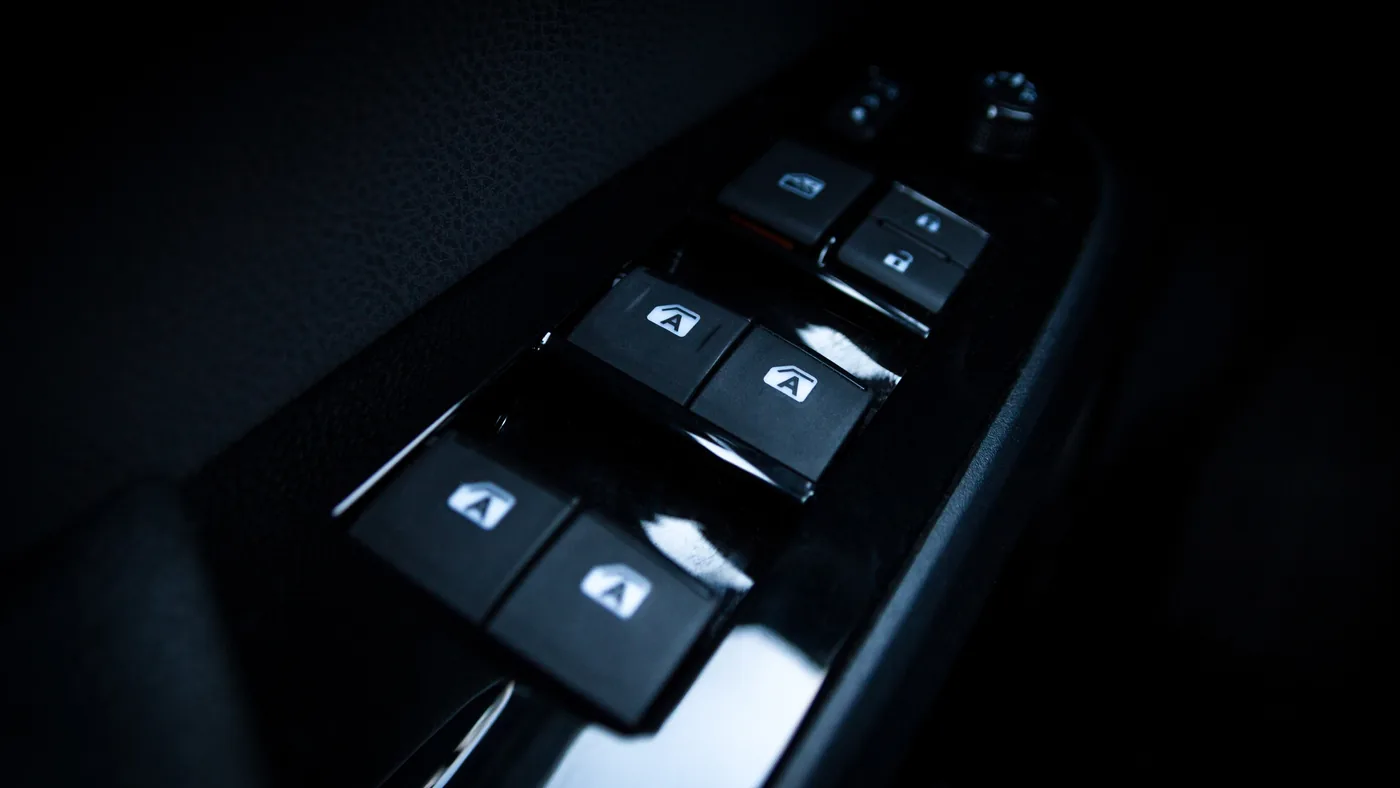
When a power window stops working
A window that stops working is usually a wear problem, not a recall, but in several recall records a dead window is the first sign of the defect. GM’s Trailblazer records say a short may cause the power door lock and window switches to “function intermittently or become inoperative” before it overheats. Honda’s 2006 CR-V record (11V456) says that if the switch fails, the windows may become inoperative. GM’s 1992 recall (92V043) describes moisture in the express-down module causing window operation without operator control. If your car is on one of these lists, the failed switch may be the recalled part.
For electrical faults beyond the windows, including other components that can overheat, see our car electrical problems guide. Wipers, mirrors and windows share NHTSA’s “visibility” category, covered in our windshield wiper guide.
What to do if your car is covered
- Check your VIN at nhtsa.gov/recalls or with our VIN decoder. Do this even if you had a window recall done before: the table above shows Honda, GM and Ford cars that were recalled again.
- Follow what the record says. Where a recall record advises parking outside until the repair is done, as the GM 12V406, 13V248, 14V404 and Honda 12V486 records do, follow it. Toyota’s 12V491 record says owners with a switch problem should not attempt repairs themselves and should contact a dealer.
- Ask whether every campaign is complete. GM’s later recalls replaced an earlier coating remedy with a new door module, and Ford’s re-recalls cover cars repaired incorrectly, so ask the dealer to confirm that no campaign on your VIN is still open.
- Report a problem such as a hot, melted or smoking switch, or a window that does not reverse, to NHTSA, even if the car is not recalled: see our guide to filing a complaint.
Recall figures are PlainVIN’s analysis of NHTSA’s files and update when we refresh the data. “Reported repaired” is the automaker’s figure. This guide is general information, not mechanical or safety advice for a specific vehicle; the official source for any recall is its NHTSA recall record.
Frequently asked questions
Which cars have a power window switch recall for melting or fire?
The largest are Toyota’s 12V491 and 15V689 for 2006–2011 Camry, RAV4, Corolla, Highlander, Tundra, Yaris and related models. Others cover the 2002–2006 Honda CR-V, 2007–2008 Honda Fit, 2006–2007 Chevrolet Trailblazer and related GM SUVs, 2014–2017 Express and Savana vans, and 2010–2014 Chrysler and Dodge minivans.
Can a power window switch catch fire when the car is off?
Some recall records say so. Honda’s 2012 CR-V recall (12V486) and GM’s Trailblazer recalls (12V406, 13V248, 14V404) say a fire could occur even when the vehicle is not in use and advised owners to park outside until the repair was done.
Is the Toyota power window switch recall still open?
Toyota reports 67% of 12V491 and 46% of 15V689 as repaired, so many covered vehicles have not had the work done. Check your VIN at nhtsa.gov/recalls.
What is FMVSS 118?
Federal Motor Vehicle Safety Standard 118 limits when power windows, partitions and roof panels may close, and requires windows that can close in other circumstances to stop and reverse before squeezing a test rod with 100 newtons or more. Pinch recalls say a vehicle fails this standard.
Why did Tesla recall its power windows?
Tesla’s 2022 recall (22V702) covered 1,096,762 2017–2022 Model 3, Model Y, Model S and Model X cars whose automatic window reversal may not react correctly after detecting an obstruction. It was fixed with an over-the-air software update, and Tesla reports 99% complete.
My window recall was already repaired. Can it be recalled again?
Yes. Honda recalled the 2007–2008 Fit again because the first remedy may have been insufficient (13V260), GM replaced coated door modules (14V404, 15V599), and Ford has re-recalled Escape, Ranger, Nautilus and Super Duty vehicles that were repaired incorrectly.
Is a power window recall repair free?
Yes. The automaker pays for the recall remedy, whether that is new grease, a new switch or door module, or a software update.
About the PlainVIN Recalls & Safety Desk
This desk covers recall campaigns and completion rates, owner complaints filed with NHTSA, and NHTSA 5-Star Safety Ratings.
Every figure in this guide links to its primary source. See our editorial policy, how we use AI and corrections log.
How this page was madeSources, processing, limits, review and changes
Data sources
- NHTSA recalls file (power window devices and controls, and recalls naming power window switches, regulators or FMVSS 118), including campaigns 08V162, 10V033, 11V456, 12V406, 12V486, 12V491, 13V248, 13V260, 14V234, 14V404, 15V599, 15V689, 16V617, 18V295, 20V768, 22V702, 23V099, 24V597, 24V953, 25V237, 25V484, 25V518, 26V374 and 26V612
Retrieved Oct 6, 2026 - NHTSA recall record, Toyota campaign 15V689
nhtsa.gov - NHTSA recall record, Honda campaign 12V486
nhtsa.gov - NHTSA recall record, Tesla campaign 22V702
nhtsa.gov - 49 CFR 571.118, Standard No. 118: Power-operated window, partition, and roof panel systems
Legal Information Institute, Cornell Law School
Processing
- Complaints are counted per component. One complaint can list several, so component totals add up to more than the total.
- Fuel cost = miles per year ÷ EPA combined mpg × EIA weekly price for your region.
Limitations
- Complaint counts are owner reports, not verified findings or failure rates. There is no sales denominator.
- Recall campaigns are listed for the model year. Only NHTSA and the automaker know whether a specific car was repaired.
- Recent model years are still collecting reports.
Review
Researched by Daniel B. and Olivia C., technical check by Ethan B., edited by Sophia M. (see the editorial team page). Drafted with AI assistance and checked against primary sources by the Recalls & Safety desk.
Changelog
- 2026-10-06 Data refreshed from the official files.
Keep reading