Key takeaways
- A VIN decoder turns the 17 characters on your car into factory facts: year, make, model, engine, body, plant and safety equipment.
- PlainVIN decodes with NHTSA's own vPIC service, then adds the recall campaigns, owner complaints, crash-test stars and fuel economy published for that model year.
- No decoder can tell you whether your specific car's recall was repaired. NHTSA's VIN lookup and the automaker can.
- Accidents, mileage and title brands aren't in the VIN; they come from a paid history report.
What a VIN decoder can and can't tell you
A VIN decoder reads the vehicle identification number your automaker assigned at the factory and translates it into facts: model year, make, model and trim, body style, engine, transmission, drive type and the assembly plant. Many VINs also unlock the safety equipment the maker filed with NHTSA, such as air-bag locations, electronic stability control and the rear-visibility camera.
What a decoder can't do is tell you anything that happened to the car after it left the plant. Accidents, odometer readings, previous owners and title brands like salvage or flood are kept by insurers and state motor-vehicle agencies, not in the VIN. Decoders work for cars, SUVs, pickups, vans, motorcycles and trailers built for the 1981 model year onward, when the 17-character format became mandatory.
From the VIN
- Year, make, model and trim
- Body, engine, transmission, drive
- Assembly plant and country
- Safety equipment, as filed with NHTSA
Not in the VIN
- Accidents and damage
- Mileage and odometer readings
- Owners and title brands
- Whether a recall was repaired
How the PlainVIN decoder works
Most free decoders stop at the spec sheet. PlainVIN starts there and then shows you what the government has on file for that exact year, make and model, with the source and date on every number.
- Decode. We send your VIN to NHTSA's Product Information Catalog and Vehicle Listing (vPIC), the federal decoder that reads the codes manufacturers file. You see every field it returns, and how many of NHTSA's fields were filled for your VIN.
- Match. The decoded year, make and model are matched to NHTSA's recall file, its owner-complaint database, the 5-Star Safety Ratings and EPA fuel-economy data.
- Explain. Recall campaigns appear with NHTSA's official text and the share of vehicles already repaired. Complaints are counted by component, so you can see what owners report most.
- Hand off. For anything only your specific car can answer, such as an open recall, we send you to the official tool.
“The information displayed through the VIN decoder is reported by the manufacturer.”National Highway Traffic Safety Administration, VIN Decoder
For example, decoding the sample VIN 1HGCR2F3XHA000000 identifies a 2017 Honda Accord LX. Its 2017 Honda Accord report then shows 3 recall campaigns and 538 owner complaints filed with NHTSA, alongside its crash-test stars and EPA mpg.
How to read a VIN, character by character
Every VIN has four sections. Positions 1–3 are the World Manufacturer Identifier, positions 4–8 describe the vehicle, position 9 is the check digit, and positions 10–17 identify this particular car, starting with the model year in position 10 and the assembly plant in position 11. The format is set by federal rule.
“Each VIN shall consist of seventeen (17) characters.”49 CFR 565.13(b)
| Pos. | Char | What it means |
|---|---|---|
| 1 | 1 | Country of manufacture: 1 = United States |
| 2 | H | Manufacturer: H = Honda |
| 3 | G | Vehicle type / division: G = passenger car |
| 4 | C | Model line (Honda code): C |
| 5 | R | Body and model: R |
| 6 | 2 | Engine and restraint codes: 2 |
| 7 | F | Body / series detail: F (a letter here means the 2010–2039 cycle) |
| 8 | 3 | Trim / restraint detail: 3 |
| 9 | X | Check digit: X = remainder 10 |
| 10 | H | Model year: H = 2017 |
| 11 | A | Assembly plant: A = Marysville, Ohio |
| 12 | 0 | Serial number |
| 13 | 0 | Serial number |
| 14 | 0 | Serial number |
| 15 | 0 | Serial number |
| 16 | 0 | Serial number |
| 17 | 0 | Serial number |
Positions 4–8 are the manufacturer's own codes, so the same character means different things to different makers. That's why the 8th digit, which many makers use for an engine code, can't be read without the maker's code list, and why a decoder that queries NHTSA's catalog is more reliable than a generic chart. Our guide to reading a VIN walks through each section with a check-digit calculator.
Who built it: World Manufacturer Identifier (WMI) codes
The first three characters, the WMI, tell you which manufacturer and often which plant region built the car. A Honda, for instance, can start with 1HG (built by American Honda), 2HG (Honda of Canada) or JHM (Honda Motor Co. in Japan). These are common WMIs and the manufacturer NHTSA has on file for each.
| WMI | Manufacturer on file with NHTSA | Vehicle type | Makes |
|---|---|---|---|
| 1FA | Ford Motor Company | Passenger car | Ford |
| 1FT | Ford Motor Company | Truck | Ford |
| 1G1 | General Motors LLC | Passenger car | Chevrolet |
| 1GC | General Motors LLC | Truck | Chevrolet |
| 1HG | American Honda Motor Co., Inc. | Passenger car | Honda |
| 2HG | Honda of Canada Mfg. | Passenger car | Honda |
| JHM | Honda Motor Co., Ltd. | Passenger car | Honda |
| 4T1 | Toyota Motor Manufacturing, Kentucky | Passenger car | Toyota |
| 2T1 | Toyota Motor Manufacturing Canada | Passenger car | Toyota |
| JTD | Toyota Motor Corporation | Passenger car | Toyota |
| 1N4 | Nissan North America, Inc. | Passenger car | Nissan, Infiniti |
| 5N1 | Nissan North America, Inc. | MPV (SUV) | Nissan, Infiniti |
| 1C4 | FCA US LLC | MPV (SUV) | Chrysler, Dodge, Jeep, Ram |
| 3FA | Ford Motor Company, Mexico | Passenger car | Ford |
| 3VW | Volkswagen de México | Passenger car | Volkswagen |
| WVW | Volkswagen AG | Passenger car | Volkswagen |
| 4S4 | Subaru of America, Inc. | MPV (SUV) | Subaru |
| 5YJ | Tesla, Inc. | Passenger car | Tesla |
| JM1 | Mazda Motor Corporation | Passenger car | Mazda |
| KMH | Hyundai Motor Co. | Passenger car | Hyundai, Genesis |
| KNA | Kia Corporation | Passenger car | Kia |
| WBA | BMW AG | Passenger car | BMW |
| WDD | Mercedes-Benz Cars | Passenger car | Mercedes-Benz |
| SAL | Jaguar Land Rover Limited | MPV (SUV) | Land Rover |
Source: NHTSA vPIC DecodeWMI. A manufacturer can hold dozens of WMIs; each make's decoder page, such as the Ford VIN decoder, lists all of them.
Model-year codes: what the 10th character means
The 10th character is the model year. Letters and numbers repeat every 30 years, and VINs never use I, O, Q, U, Z or 0 for the year. For cars, SUVs and light trucks, a letter in position 7 means the 2010–2039 cycle; a number means 1980–2009. So H means 2017 when position 7 is a letter, and 1987 when it is a number.
The check digit: how a decoder spots a mistyped VIN
Position 9 is calculated from the other 16 characters. Letters become numbers, each position has a weight, and the weighted sum divided by 11 leaves a remainder of 0–9 (or 10, written X). If the result doesn't match position 9, a character was almost certainly copied wrong. In our example VIN 1HGCR2F3XHA000000 the remainder is 10, so the check digit is X.
| Character | 1 | H | G | C | R | 2 | F | 3 | X | H | A | 0 | 0 | 0 | 0 | 0 | 0 |
|---|---|---|---|---|---|---|---|---|---|---|---|---|---|---|---|---|---|
| Value | 1 | 8 | 7 | 3 | 9 | 2 | 6 | 3 | — | 8 | 1 | 0 | 0 | 0 | 0 | 0 | 0 |
| × Weight | 8 | 7 | 6 | 5 | 4 | 3 | 2 | 10 | 0 | 9 | 8 | 7 | 6 | 5 | 4 | 3 | 2 |
| = Product | 8 | 56 | 42 | 15 | 36 | 6 | 12 | 30 | — | 72 | 8 | 0 | 0 | 0 | 0 | 0 | 0 |
The method, letter values and weights are fixed in 49 CFR 565.15. A mismatch can also happen on a vehicle built for another market, where the check digit isn't required; our decoder still sends the VIN to NHTSA and shows what comes back.
Where to find your VIN
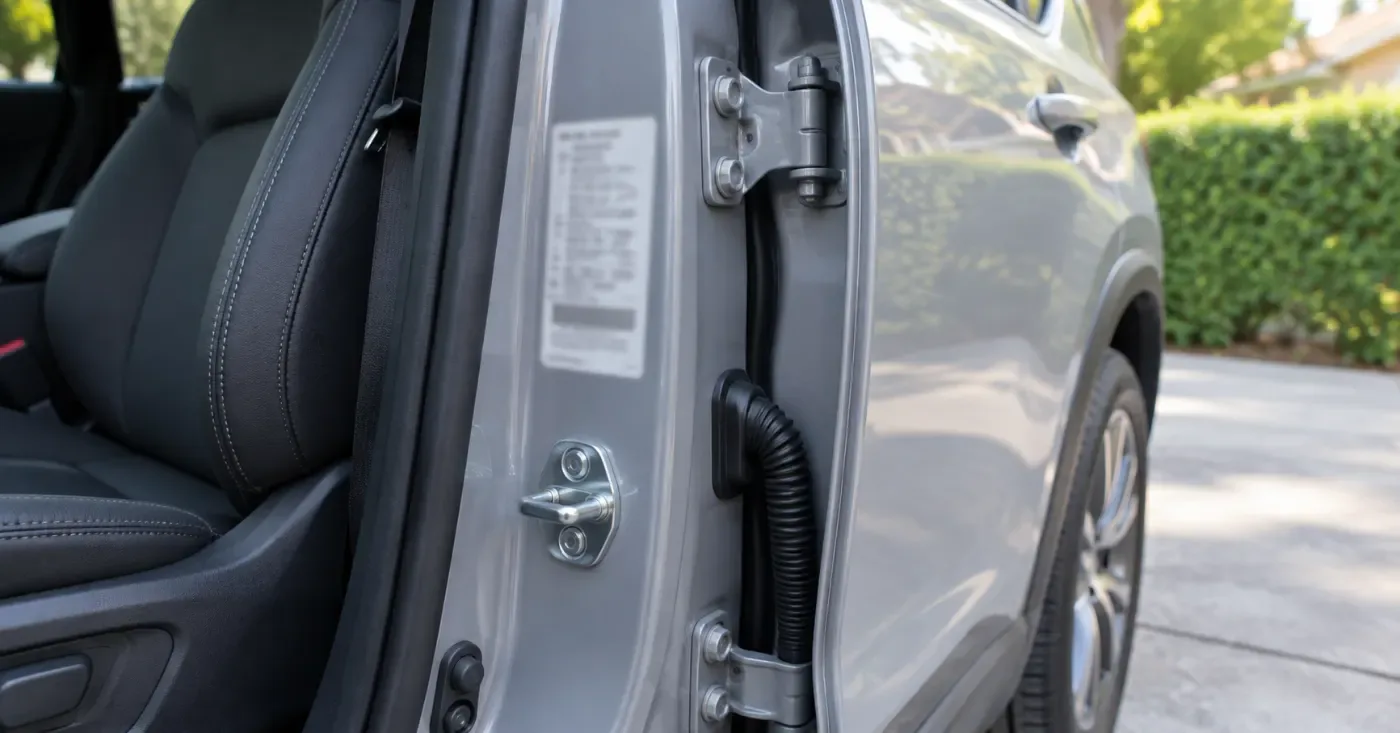
Look through the windshield at the driver's-side corner of the dashboard, or open the driver's door and read the label on the door jamb. It's also printed on your title, registration and insurance card. On passenger cars, SUVs and light trucks, federal rules require the dashboard VIN to be readable from outside the car.
Where the VIN is on cars, pickups, vans and motorcycles →Recalls: what a VIN decode can and can't confirm
A decoder tells you which recall campaigns NHTSA lists for the model year. It can't tell you whether your car was one of the vehicles covered or whether the repair was done; only the automaker's records, searched through NHTSA's VIN recall lookup, can.
One detail many sites get wrong: recall repairs are free under federal law, but not for every car. The free-remedy rule doesn't apply to a vehicle first sold more than 15 calendar years before the recall notice, or a tire sold more than 5 years before (49 U.S.C. 30120(g)).
That's why every recall card on PlainVIN says “Not checked against your VIN” and links to the official lookup. Browse campaigns by model year on the recall lookup.
Decode by make
Each make's decoder lists every WMI that manufacturer has on file with NHTSA, its most-reported models and its latest recall campaigns.
Free VIN decoder, VIN check or paid history report?
The three names get mixed up. A decoder reads factory facts from the VIN. A VIN check usually means a decode plus open-recall status. A history report compiles records about the individual car: title brands, odometer readings, reported accidents and sometimes service visits.
| What you get | PlainVIN (free) | Paid history report |
|---|---|---|
| Factory specs: year, engine, plant | Included | Included |
| Recall campaigns for the model year | Included | Varies |
| Owner complaints filed with NHTSA | Included | Not included |
| Crash-test stars and MPG | Included | Varies |
| Accidents and damage reports | Not included | Included |
| Title brands (salvage, flood) | Not included | Included |
| Odometer readings and owners | Not included | Included |
| Price | Free | Paid per report |
Use both, in order: decode first to confirm the car is what the seller says, then buy a report only for a car you're serious about. The Justice Department's NMVTIS program lists the approved providers of title-history reports. Our free VIN check vs history report guide explains what each one covers.
Is it OK to share your VIN?
Your VIN isn't secret: on most cars it's readable through the windshield by design, and sellers routinely list it in ads. It identifies the vehicle, not you. Personal information that state motor-vehicle agencies hold, such as an owner's name and address, is protected by the federal Driver's Privacy Protection Act (18 U.S.C. 2721), which limits who can get it.
Sharing a VIN with a buyer, insurer, dealer or a decoder is normal. If you're selling, it helps buyers check the car; if you're buying, ask for it before you travel to see a car, decode it, and compare it with the dashboard, door label and title when you get there.
VIN decoder FAQ
Is this VIN decoder really free?
Yes. There's no signup, no paywall and no paid report to unlock. PlainVIN is paid for by labelled ads on reference pages; decode results never carry ads.
What information can someone get from a VIN?
The factory facts: model year, make, model, trim, body, engine, transmission, drive type, assembly plant and the safety equipment the maker filed with NHTSA. With the year, make and model, you can also look up recall campaigns, owner complaints and crash-test ratings. A VIN does not reveal the owner.
Can a VIN tell me if a car has been in an accident?
No. A VIN decoder reads factory facts. Accident, title and odometer records sit with insurers and state agencies, which is what paid history reports compile.
What does the 8th digit of a VIN tell you?
It's part of the vehicle descriptor section (positions 4–8), which each manufacturer defines for itself. Many makers use it for an engine code, but the meaning depends on the make and year, which is why a decoder that queries NHTSA's catalog is the reliable way to read it.
Why are some fields blank?
Blank means NHTSA has no data for that field, not that the car lacks the feature. Older VINs usually return far fewer fields than newer ones.
Does PlainVIN check whether my car's recalls were repaired?
No. We list every recall campaign NHTSA has for the model year. Only NHTSA's VIN lookup and your automaker can say whether your specific car was repaired.
Can someone do something with my VIN number?
A VIN identifies the car, not the owner, and on most cars it's visible through the windshield. Owner details held by state agencies are protected by the Driver's Privacy Protection Act. Sharing it with a buyer, dealer or insurer is normal.
What does it mean if the check digit doesn't match?
Usually a typo. It can also happen with VINs built for markets outside North America, where the check digit isn't required. We still send the VIN to NHTSA and show what it returns.
How do I decode a VIN from before 1981?
Before the 1981 model year, automakers used their own shorter formats, so this tool can't decode them. Owners' clubs and the maker's archives are the best sources.
Do you store the VINs I enter?
We don't save the VINs you decode to a database or an account. Your VIN is sent to NHTSA to decode and appears in the result page's address, so it can show up in our host's standard server logs, which are kept for security only. My Garage saves the year, make and model, not the VIN.
How this page was madeSources, processing, limits, review and changes
Data sources
- NHTSA vPIC VIN decoder (DecodeVinValues)
Queried live when you decode · public domain - NHTSA recalls by vehicle
Retrieved Oct 6, 2026 - US DOT recall completion rates (data.transportation.gov)
Retrieved Oct 6, 2026 - NHTSA ODI owner complaints
Retrieved Oct 6, 2026
Processing
- We send your VIN to NHTSA vPIC and show the fields it returns; empty fields are hidden by default.
- Recalls and complaints are matched by the decoded year, make and model, not by your VIN.
Limitations
- Complaint counts are owner reports, not verified findings or failure rates. There is no sales denominator.
- Recall campaigns are listed for the model year. Only NHTSA and the automaker know whether a specific car was repaired.
- Recent model years are still collecting reports.
Review
Reference text reviewed by the Vehicle Data Desk.
Changelog
- 2026-10-06 Data refreshed from the official files.